When Family Fractures: Reflections on Estrangement, and Healing
BELONGINGSTORYTELLING
11/26/20254 min read
Recently, I listened to a podcast that evoked in me an emotional theme that has lived quietly in the background of my life.
It spoke of children breaking ties with parents, of siblings drifting into silence, and of parents choosing distance from their children.
As I listened, my own story echoed back at me. Estrangement has touched my primary family too, growing quietly and painfully in the spaces between us. I often felt that my mother’s death shifted the entire inner emotional landscape of our family, bringing unhealed wounds to the surface with full force, as if grief itself had pulled every hidden fracture into the light. These questions have followed me for years like shadows:
What went wrong? Why do families fall apart? And what unseen force creates such vast distances between people?
The Emotional Cycles We Don’t Speak About
There were years when I cried rivers, blamed myself, then blamed my family, felt anger toward myself, then anger toward them, and circled through longing, confusion, rage, and grief.
These weren’t just emotions, they were portals into deeper contemplations about the role of family in human life.
When conflict isn’t spoken aloud, when clarity is missing, we are left searching through childhood memories like old, dusty boxes, hoping for answers that may never come.
The Weight of Expectations: Family as a Sacred Archetype
In many cultures, and especially in traditional environments, we are taught that family is sacred, that we must never walk away, no matter the harm. Some spiritual circles even say: “You cannot heal until you heal your family ties.”
As someone devoted to healing, my own and that of others, these ideas challenged me deeply. They stirred questions: What is the true role of our primary family in our lives? What happens when we choose firm boundaries? Is distance always a wound—or can it also become a kind of medicine?
I began questioning my own role within the family dynamic. What was I meant to learn here? What was this experience trying to teach me? And how do I break unhealthy cycles of distance if, at times, I also need to create distance myself?
Through this complex inner process, I learned that there are many directions one can take from fostering small, intentional connections within the space that remains,
to unlearning socially conditioned narratives that insist we must stay close even when closeness is harmful.
In this landscape of healing, there is no single path only the one that leads us back to integrity, clarity, and compassion for ourselves.
The Complexity Behind Estrangement
After my mother passed away, the fabric of my primary family began to unravel.
I sought answers in therapy, in family constellations, in spiritual work, and in long self-reflection.
I began to understand the layers behind the choices my sister made to leave without clear communication. I saw the complexity behind my father’s inability to create space for dialogue. And I recognized the complexity behind my own need to distance myself at times.
Whenever I witnessed other families, especially the tender, steady love between the parents of my partner, I felt waves of guilt, discomfort, and heartache. But slowly, I learned something essential: Discomfort is not a verdict. It is an invitation to accept ourselves fully, even the broken, aching parts.
Unlearning Social Conditioning to Find Personal Truth
One of the most profound lessons I have learned is the importance of releasing social conditioning around family. We must give ourselves permission to take distance when distance is needed for safety, clarity, or healing.
I have learned that creating alternative families—chosen families—is not only valid but profoundly sacred. My inner wisdom teaches me that care, belonging, and safety do not have to be inherited, they can be created. They can be claimed. They can be built with intention, love, and reciprocity.
I have given myself permission to form my own alternative family: with my loving partner, with our children, and with a community of women whose presence feels like a circle of soft, steady hands. These friendships woven through solidarity, truth-telling, and emotional labor, have taught me that family can be expansive, fluid, and empowering.
I learned that these permissions are not selfish, they challenge the patriarchal idea that blood ties must be obeyed at all costs, that the “traditional family” is the only sanctified structure, or that we must endure harm for the sake of harmony.
At the same time, I try to look at my primary family with compassion, not to excuse the pain, but to understand how these experiences can serve my healing, and our collective healing.
I am learning to honor my dignity, the dignity of others, and my own sense of healthy boundaries, rooted not in guilt, but in self-respect, clarity, and the deep knowing
that family is not defined by obligation, but by mutual care, safety, and the freedom to be fully ourselves.
Healing Without a Map
Maybe contact with family will change one day. Maybe it never will.
But neither outcome determines our worthiness or our capacity to receive love, care, or belonging.
Listening to that podcast reminded me that our collective vocabulary around harm, emotional abuse, and boundaries has evolved. We are becoming more aware, more attuned, to the ways wounds are created and inherited.
Healing is not always about reunion. Sometimes it is about truth, the quiet truth of what happened, what was missing, what was too heavy for us to carry alone.
Sometimes healing is about safety, choosing environments where our nervous system can exhale, where our voice is not silenced, where our boundaries are not treated with judgement.
Healing does not always return us to the people we came from. Often, it returns us to ourselves, to the parts that were abandoned, ignored, or dimmed so we could survive.
Reunion can be beautiful when it is mutual, conscious, and rooted in accountability.
But healing can also mean accepting that some doors remain closed.
Sometimes healing asks us to step forward, not to repair what broke, but to honor what we learned.
To choose peace over performance. Safety over loyalty. Truth over tradition.
And ourselves over the narratives that once defined us.
The Only Photograph We Have
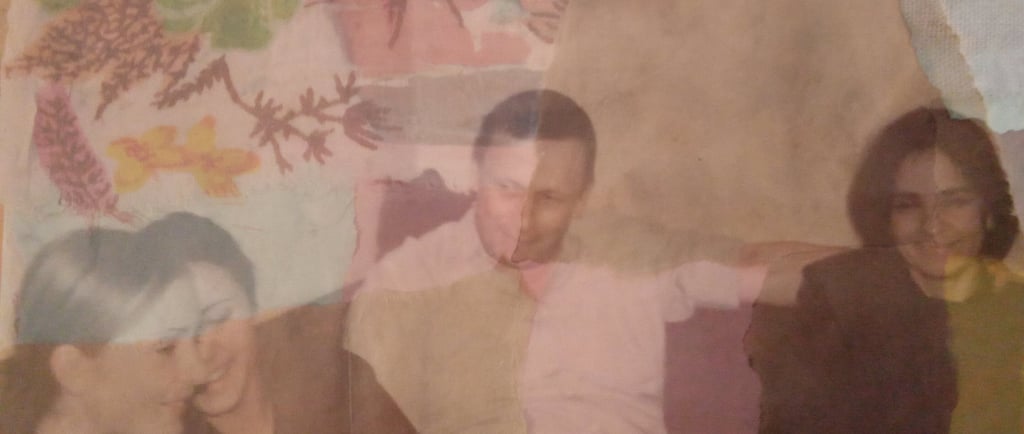
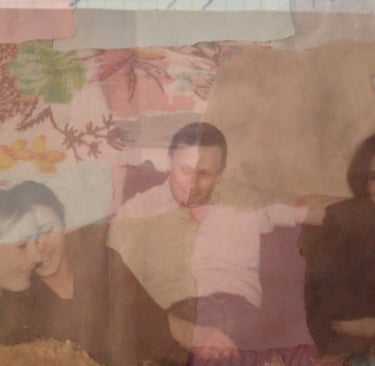
The photo I am sharing here is the only photograph I have of my family, a single frame, captured in time, holding all the tenderness, the fractures, the questions, and the unspoken stories that came before and after it.